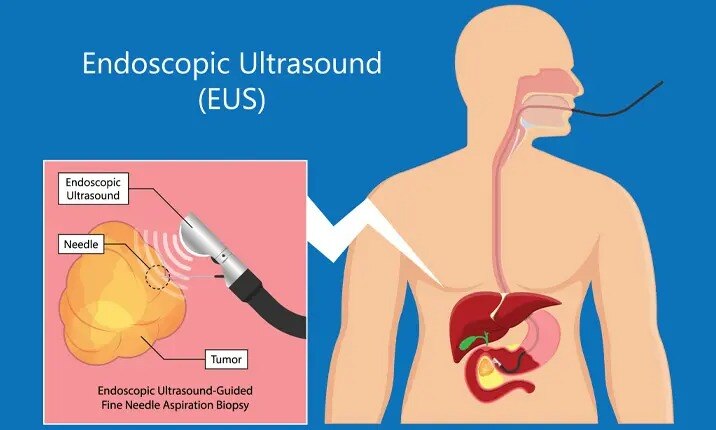
Persistent upper-abdominal pain, vomiting, jaundice, weight loss, or abnormal liver and pancreatic tests can point beyond ordinary acidity or indigestion. By the end, you will know when EUS is a sensible next step, what it can examine, how it differs from ERCP and other tests, and how to prepare for a consultation in Mira Road.
Key takeaways
- Ask about EUS when symptoms or scans suggest pancreatic, bile-duct, or stomach-wall disease.
- EUS can examine structures routine endoscopy cannot reach or show clearly.
- Bring scan reports, blood-test results, medication details, and previous endoscopy records.
- Choose a service that explains the clinical question, preparation, sampling, and follow-up plan.
When digestive symptoms justify asking about EUS
Persistent upper-abdominal pain, unexplained weight loss, recurrent vomiting, jaundice, or abnormal liver-function, amylase, or lipase results can justify asking whether EUS would answer a specific clinical question. It becomes more useful when symptoms or an earlier scan suggest disease in the pancreas, bile ducts, gallbladder, stomach wall, oesophagus, or nearby lymph nodes.
EUS for digestive symptoms Mira Road is not usually the starting point for ordinary acidity, gas, constipation, or uncomplicated dyspepsia. A clinician may begin with a history, medication review, H. pylori testing where appropriate, blood tests, abdominal ultrasound, or routine gastroscopy. Colonoscopy fits lower-abdominal symptoms, altered bowel habit, or rectal bleeding more closely.
| Test or situation | Usually useful first for | Why EUS may or may not follow |
|---|---|---|
| Abdominal ultrasound | Gallbladder, bile ducts, and broad upper-abdominal screening | EUS can clarify a small or uncertain abnormality |
| CT or MRI | A broad abdominal survey or suspected solid mass | EUS provides close-range detail and possible tissue sampling |
| MRCP | Bile-duct and pancreatic-duct anatomy | EUS can investigate a suspected stone, lesion, or narrowing |
| Colonoscopy | Rectal bleeding or altered bowel habit | It examines the colon, not the pancreas or bile ducts |
Ask about EUS for stomach symptoms when gastroscopy shows persistent wall thickening, or when the lining looks normal but a deeper lump, external compression, or nearby lymph node needs assessment. EUS is also relevant after an abnormal scan, unexplained jaundice, suspected pancreatic or bile-duct disease, or persistent symptoms that simpler tests have not explained.
What EUS can show when routine endoscopy is not enough
A standard gastroscopy sees the mucosal surface of the oesophagus, stomach, and duodenum. EUS adds a high-frequency ultrasound probe, showing the separate layers of the gut wall and structures outside it. That difference matters when the lining looks normal but a deeper lesion or external compression remains possible.
Before booking, ask what specific question the examination must answer:
- Is persistent stomach-wall thickening caused by a deep wall lesion?
- Is a subepithelial lump beneath normal-looking mucosa present?
- Are nearby lymph nodes enlarged, or is there an abnormality beside the digestive tract?
- Does the pancreas, bile duct, gallbladder, or surrounding tissue need close-range assessment?
EUS is a problem-solving test, not a replacement for every scan.
| Test | Main strength | Limitation |
|---|---|---|
| Abdominal ultrasound | Broad initial view of abdominal organs | Gas, body habitus, and small lesions can limit detail |
| CT | Wider survey and solid-mass assessment | Uses radiation and may not characterise small wall lesions fully |
| MRI or MRCP | Soft-tissue and duct anatomy | Less suitable for direct wall-layer assessment or tissue sampling |
| EUS | Close views of gut-wall layers, pancreas, ducts, and nearby nodes | Invasive and not the best first test for every symptom |
EUS for stomach symptoms is not automatically useful for ordinary reflux, gas, constipation, or uncomplicated pain. An incidental pancreatic cyst, gallbladder polyp, or benign lump still needs matching against your symptoms, blood tests, and earlier imaging. A search for endoscopic ultrasound Mira Road should begin with that clinical question, not location alone.
EUS for pancreatic and bile-duct conditions: diagnosis, sampling, or treatment
Diagnostic EUS is a close-range ultrasound examination of the pancreas, pancreatic ducts, bile ducts, gallbladder, stomach wall, and nearby lymph nodes. It can investigate a small pancreatic lesion, pancreatic cyst, chronic-pancreatitis changes, bile-duct narrowing, suspected bile-duct stones, or unexplained jaundice after initial imaging.
EUS for pancreatobiliary conditions is usually a problem-solving test after CT or MRI/MRCP, not a replacement for every scan.
Sampling adds a needle procedure to imaging. The checklist is:
- EUS-guided fine-needle aspiration (FNA) collects cells from a pancreatic mass, lymph node, or selected cyst.
- Fine-needle biopsy (FNB) is often chosen when a histological core and tissue architecture matter, such as when lymphoma or autoimmune disease is suspected.
- Cyst-fluid CEA helps classify a cyst as mucinous or non-mucinous; it does not, by itself, prove or exclude cancer.
- Therapeutic EUS is different: experienced teams may drain selected pancreatic-fluid collections or the bile ducts when ERCP fails or is not feasible.
EUS and ERCP serve different purposes:
| Option | Main role | Typical use |
|---|---|---|
| EUS | Diagnosis and tissue sampling | Assess a lesion or obtain FNA/FNB |
| ERCP | Treatment | Extract stones, place a stent, or drain a bile duct |
| EUS or MRCP | Non-invasive stone assessment | Intermediate probability of common-bile-duct stones, helping avoid unnecessary ERCP and its pancreatitis risk |
Diagnostic EUS without a needle is generally lower risk than FNA, FNB, or therapeutic EUS. Ask an endoscopic ultrasound Mira Road service which procedure is planned and how it manages bleeding, infection, perforation, pancreatitis, or stent blockage.
What to bring and how to prepare for the procedure
Bring your records and follow the endoscopy unit’s written instructions, because fasting times, medication changes, and sedation policies differ. This checklist is useful for anyone arranging EUS for digestive symptoms Mira Road.
1. Bring reports from previous ultrasound, CT, MRI, or MRCP examinations. Carry the actual image files or discs when available, not only the written reports.
2. Add previous gastroscopy, colonoscopy, or other endoscopy reports. Bring recent blood-test results, including liver-function tests, bilirubin, amylase, or lipase if those tests were performed.
3. Write down every medicine, its dose, and when you take it. Include allergies, any previous reaction to sedation, sleep apnoea, heart disease, lung disease, diabetes, and other important conditions.
4. Tell the team specifically about warfarin, apixaban, rivaroxaban, clopidogrel, aspirin, and other anticoagulant or antiplatelet medicines. Do not stop or change them without the endoscopy team’s instruction.
5. Ask exactly when to stop solid food and clear liquids. If you have diabetes, ask for a revised plan for insulin or diabetes tablets rather than guessing.
6. Ask whether you need an adult escort and supervision after sedation. Do not drive or make important decisions until the unit confirms that recovery is complete.
Diagnostic EUS without a needle is generally lower risk than FNA, FNB, or therapeutic EUS. Consent should cover sedation events, bleeding, infection, perforation, and pancreatitis; cyst aspiration or drainage also carries infection risk and may require antibiotics under local protocol.
How to choose an EUS service in Mira Road
Choose an EUS service by its complete pathway, not by its location or the title “gastroenterologist.” An EUS specialist in Mira Road should offer diagnostic EUS and explain when EUS-guided FNA or FNB, ERCP, or therapeutic EUS is appropriate.
Ask these questions before booking:
- Who reviews your CT or MRI with the endoscopist, and what clinical question will EUS answer?
- Does the unit have trained sedation support plus suitable radial and linear EUS equipment?
- Where will tissue go for cytology or histopathology, and how will you receive the result?
- What emergency support is available for bleeding, infection, perforation, pancreatitis, or stent blockage?
- Who follows you after the procedure, including after biopsy, drainage, or stent placement?
| Service feature | What to verify | Why it matters |
|---|---|---|
| Diagnostic EUS | Imaging of the gut wall, pancreas, bile ducts, gallbladder, and lymph nodes | Confirms whether the scan addresses your symptoms |
| FNA or FNB | Needle choice, number of passes, and pathology handling | FNB may provide tissue architecture when cytology alone is insufficient |
| Therapeutic EUS and ERCP | Experience with drainage, stones, and stents | Advanced treatment needs imaging, sedation, and emergency backup |
Endoscopic ultrasound in Mira Road is not automatically the right next step. It can reveal an incidental pancreatic cyst, gallbladder polyp, or benign subepithelial lesion. Match the finding to your pain pattern, blood tests, earlier imaging, and risk factors before biopsy or treatment.
Dr Ravindra Surude 08042756059 can help decide whether EUS, another investigation, or no immediate procedure fits the clinical question.
Related service
Gastrointestinal endoscopy procedures Endoscopic Ultrasound (EUS) by Dr. Ravindra Surude Advanced Diagnostic & Therapeutic GI Imaging Dr. View service → |
Frequently asked questions
When should you ask about EUS for digestive symptoms?
Ask when persistent upper-abdominal pain, unexplained weight loss, recurrent vomiting, jaundice, or abnormal liver-function, amylase, or lipase results require a closer look.
What can EUS show when routine endoscopy is not enough?
EUS can assess the pancreas, bile ducts, gallbladder, stomach wall, oesophagus, and nearby lymph nodes when routine endoscopy does not show the suspected problem clearly.
Can EUS diagnose or treat pancreatobiliary conditions?
EUS can help investigate pancreatic and bile-duct conditions, guide tissue sampling when needed, and support selected therapeutic procedures.
How should you prepare for EUS?
Bring scan reports, blood-test results, medication details, and earlier endoscopy records. Follow the service's fasting and medication instructions before the procedure.